PDF Ebook Capitalism, Democracy, and Ralph's Pretty Good Grocery., by John Mueller
Guide Capitalism, Democracy, And Ralph's Pretty Good Grocery., By John Mueller will certainly constantly provide you good value if you do it well. Finishing guide Capitalism, Democracy, And Ralph's Pretty Good Grocery., By John Mueller to read will certainly not become the only objective. The goal is by getting the good value from guide until completion of guide. This is why; you should discover even more while reading this Capitalism, Democracy, And Ralph's Pretty Good Grocery., By John Mueller This is not only how quick you review a book and not just has the amount of you finished the books; it has to do with just what you have actually acquired from guides.
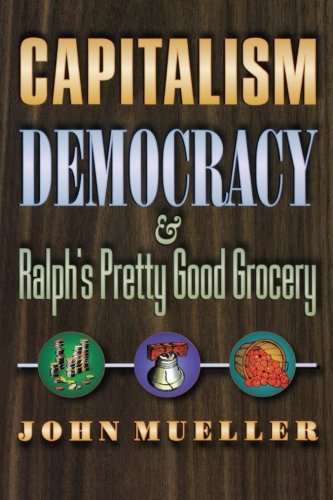
Capitalism, Democracy, and Ralph's Pretty Good Grocery., by John Mueller

PDF Ebook Capitalism, Democracy, and Ralph's Pretty Good Grocery., by John Mueller
Tips in deciding on the very best book Capitalism, Democracy, And Ralph's Pretty Good Grocery., By John Mueller to read this day can be gained by reading this page. You can locate the very best book Capitalism, Democracy, And Ralph's Pretty Good Grocery., By John Mueller that is marketed in this globe. Not just had guides released from this nation, however also the other nations. And currently, we suppose you to check out Capitalism, Democracy, And Ralph's Pretty Good Grocery., By John Mueller as one of the reading products. This is just one of the most effective books to accumulate in this website. Consider the resource and also look the books Capitalism, Democracy, And Ralph's Pretty Good Grocery., By John Mueller You could discover lots of titles of guides offered.
The factor of why you could obtain and get this Capitalism, Democracy, And Ralph's Pretty Good Grocery., By John Mueller quicker is that this is guide in soft documents form. You can check out the books Capitalism, Democracy, And Ralph's Pretty Good Grocery., By John Mueller any place you desire even you remain in the bus, office, house, and other areas. Yet, you may not should relocate or bring the book Capitalism, Democracy, And Ralph's Pretty Good Grocery., By John Mueller print any place you go. So, you won't have bigger bag to bring. This is why your option to make far better principle of reading Capitalism, Democracy, And Ralph's Pretty Good Grocery., By John Mueller is truly valuable from this instance.
Understanding the way how you can get this book Capitalism, Democracy, And Ralph's Pretty Good Grocery., By John Mueller is additionally useful. You have been in ideal website to start getting this details. Obtain the Capitalism, Democracy, And Ralph's Pretty Good Grocery., By John Mueller web link that we offer here and visit the web link. You can get guide Capitalism, Democracy, And Ralph's Pretty Good Grocery., By John Mueller or get it as quickly as possible. You can promptly download this Capitalism, Democracy, And Ralph's Pretty Good Grocery., By John Mueller after obtaining bargain. So, when you require guide swiftly, you could directly get it. It's so simple therefore fats, right? You should choose to through this.
Simply attach your gadget computer system or gizmo to the net attaching. Get the modern-day technology to make your downloading Capitalism, Democracy, And Ralph's Pretty Good Grocery., By John Mueller finished. Also you do not want to check out, you could straight shut guide soft file and open Capitalism, Democracy, And Ralph's Pretty Good Grocery., By John Mueller it later on. You can additionally quickly get the book anywhere, since Capitalism, Democracy, And Ralph's Pretty Good Grocery., By John Mueller it remains in your gizmo. Or when remaining in the office, this Capitalism, Democracy, And Ralph's Pretty Good Grocery., By John Mueller is additionally advised to read in your computer system tool.
Democracy is overrated. Capitalism, on the other hand, doesn't get enough credit. In this provocative and engaging book, John Mueller argues that these mismatches between image and reality create significant political and economic problems--inspiring instability, inefficiency, and widespread cynicism. We would be far better off, he writes, if we recognized that neither system is ideal or disastrous and accepted instead the humdrum truth that both are "pretty good." And, to Mueller, that means good enough. He declares that what is true of Garrison Keillor's fictional store "Ralph's Pretty Good Grocery" is also true of democracy and capitalism: if you can't get what you want there, "you can probably get along without it."
Mueller begins by noting that capitalism is commonly thought to celebrate greed and to require discourtesy, deceit, and callousness. However, with examples that range from car dealerships and corporate boardrooms to the shop of an eighteenth-century silk merchant, Mueller shows that capitalism in fact tends to reward behavior that is honest, fair, civil, and compassionate. He argues that this gap between image and reality hampers economic development by encouraging people to behave dishonestly, unfairly, and discourteously to try to get ahead and to neglect the virtuous behavior that is an important source of efficiency and gain.
The problem with democracy's image, by contrast, is that our expectations are too high. We are too often led by theorists, reformers, and romantics to believe that democracy should consist of egalitarianism and avid civic participation. In fact, democracy will always be chaotic, unequal, and marked by apathy. It offers reasonable freedom and security, but not political paradise. To idealize democracy, Mueller writes, is to undermine it, since the inevitable contrast with reality creates public cynicism and can hamper democracy's growth and development.
Mueller presents these arguments with sophistication, wit, and erudition. He combines mastery of current political and economic literature with references to figures ranging from Plato to P. T. Barnum, from Immanuel Kant to Ronald Reagan, from Shakespeare to Frank Capra. Broad in scope and rich in detail, the book will provoke debate among economists, political scientists, and anyone interested in the problems (or non-problems) of modern democracy and capitalism.
- Sales Rank: #460616 in Books
- Brand: Brand: Princeton University Press
- Published on: 2001-09-01
- Released on: 2001-08-19
- Original language: English
- Number of items: 1
- Dimensions: 9.21" h x .79" w x 6.14" l, 1.07 pounds
- Binding: Paperback
- 352 pages
- Used Book in Good Condition
From Publishers Weekly
"If you can't get it at Ralph's, you can probably get along without it" is the motto of the mom-and-pop retailer in Garrison Keillor's fictional town of Lake Wobegon, Minn. It's a slogan that serves Mueller, a University of Rochester political science professor, as an adroit summation of both capitalism and democracy. Both are imperfect systems, according to Mueller. Capitalism is driven by selfish acquisitiveness and provides no guarantees of economic security; democracy is preferable to other forms of government but is dominated by special interests and, as a result, is "unlikely ever to achieve orderly deliberation, political equality, or wide and enlightened participation by the mass of the public." Both concepts suffer from serious image problems, according to Mueller. Capitalism gets a bad rap from Hollywood, the church and intellectuals who decry the rapaciousness of the business world; in fact, capitalism actually rewards such virtues as honesty, fairness and civility, he writes. Democracy, on the other hand, is idealized and can never foster the orderly, fair society to which its advocates aspire. Mueller is an entertaining guide through economic and political history, using references to Shakespeare, Adam Smith, Hume, Mencken and many more writers to produce deft explanations of complex ideas. One may question the wisdom of his faith in the free market, or in the fairness and civility of big corporations that, these days, are gradually devouring the Ralph's Groceries of the world. But it's hard not to find much to like in a brash manifesto that proudly extols the virtues, as Mueller puts it, of "the pretty good over the ideal." (Oct.)
Copyright 1999 Reed Business Information, Inc.
From Library Journal
The thesis behind Mueller's cleverly worded title is that capitalism gets terrible press (for promoting greed and deceit) while democracy's is na?vely positive and uncritical (it can never be as egalitarian and participatory as it claims). Mueller (political science, Univ. of Rochester) feels that Ralph's Pretty Good Grocery, from Garrison Keillor's mythical Lake WobegonAthe motto is, "If you can't get it at Ralph's, you can probably get along without it"Ais a more realistic model for approaching the two entities. Mueller argues that our unrealistic images of capitalism and democracy prevent us from claiming the full benefit of each. Throughout, he is careful to qualify rather than make bold declarative statements that would be damned by exceptions. Many thought-provoking ideas are packed into this nuanced work, and Mueller's case is strong and well documented. The sophisticated argument, however, will limit its value to academic collections or public libraries where there is an active interest in political science.APatrick J. Brunet, Western Wisconsin Technical Coll. Lib., La Crosse
Copyright 1999 Reed Business Information, Inc.
From Booklist
Mueller is a political science professor at the University of Rochester who has varied interests. He has written books on how public opinion affects military policy, on the obsolescence of major war, and on the dance films of Fred Astaire. This new book is based on a simple assumption that likely will be challenged all along the political spectrum. Mueller asserts that capitalism is not nearly so bad as its critics claim and that we expect too much from democracy. Fans of Garrison Keillor will recognize Ralph's as the store where, if an item isn't stocked, you probably don't really need it. This is the analogy Mueller intends. Neither capitalism nor democracy is perfect, but both are "pretty good!" Mueller traces the development of democracy and capitalism worldwide during the past two centuries. Citing from an eclectic assortment of sources--his bibliography runs 25 pages--he explores and contrasts the strengths, shortcomings, and vagaries of capitalism and democracy, and analyzes the connections between the two philosophies. David Rouse
Most helpful customer reviews
2 of 2 people found the following review helpful.
worth reading, but not what you think
By Caraculiambro
I thought this was another book along the lines of "Freakonomics," "Naked Economics," or "Predictably Irrational," where the goal was to showcase a slew of counter-intuitive insights from economics and psychology -- the "Economics Can Be Fun" genre, if you will.
Not so. Though I got a lot out of this book, and parts of it made me think, on the whole I would characterize it as stuffy and uncomfortably theoretical.
It's philosophy, really. It's really a survey of how two ideas -- capitalism and democracy -- have been viewed over the years. It examines the ways in which, to paraphrase the first line of the book, capitalism has gotten a worse rap than it deserves, while democracy has gotten a better one than it deserves. (At the hands of poets, historians, novelists, politicians, etc.) It's almost literary history.
So a lukewarm recommendation for this one. There were parts that made me think, but now that I think about it, even those parts were really the author's quoting somebody else's ideas (quite a lot of this here), than coming up with anything original. On the whole, I'd say it's a lot less fun than the groovy cover and loony title seem to promise.
2 of 2 people found the following review helpful.
A seminal book, best in class
By Knoebel
Prof.Mueller tries to correct several misconceptions about capitalism and democracy.
a) Quite contrary to popular beliefs and the propaganda from a deafening chorus of anticapitalist voices Prof.Mueller posits, that capitalism tends to reward positive ethical behavior. "Nice guys come out first" .
b) For a variety of reasons this simple truth became obscured and capitalism tends to be maligned and is believed to be governed by the opposite priciples of theft, deception and moral depravity.
Reading Prof.Mueller`s book I remembered the opening line of a letter, Karl Marx wrote 1872 in reply to an article in a German business paper ("Concordia"). Summarily Marx adressed producers ("Fabrikanten") as experts in counterfeiting their merchandise.
This contrasts eerily with research findings, Prof.Mueller cites, which attest English and German producers a marked shift towards ethical behaviour during the 19.th century!
c) Following Prof.Mueller, democracy may be described to be the rule of a minority with acquiescence of the majority. And this minority rule with majority asquiescence happens to be not a defect but a
strongpoint. There may even be democracy without elections, because not the ballot box is to be considered the heart of a democratic government but the responsiveness towards special interests from society, which must be given the guarantee of peaceful pursuit against those in power.
Following the author`s very sensible train of thoughts I started wondering, wether we could call the period of Kaiserreich" in German history 1870 to 1914 a democratic period and there may be room for a democratic development in China - even without challenging the one-party rule.
I can gladly label Prof.Mueller`s book the most important title about capitalism and democracy I ever read. This is a seminal book for many years to come. I am very fortunate, to have come across it! Thank you indeed, John Mueller!
15 of 15 people found the following review helpful.
A challenging look at capitalism and democarcy
By The Independent Review, Winter 2001
Although capitalism and democracy are regarded by many as the twin engines propelling the United States into its present position of world leadership, discussions of what these institutions mean for Amercians in practical, everyday terms are exceedingly rare. John Mueller, a professor of political science at the University of Rochester, has taken a giant step toward examining the reality of capitalism and democracy...As he puts it, capitalism and democracy consistently fall short of the images and ideas conveyed by theorists and pundits.
Mueller is convinced that the free-market economy has proven its value. Government intervention cannot instill the values essential to successful enterprise, and over the long run it undercuts them...In any event, economic inequality is inevitable, whatever the economic system in place, and capitalism has the advantage over other systems of providing greater prosperity and rewarding moral behavior...
Whereas Mueller focuses on the negative images frequently associated with capitalism, his discussion of democracy concentrates on the unattainable ideal by which it is often judged...Especially important from Mueller's perspective is recognition of the fact that special interests and inequality are inherent in democratic systems...
Democracy may be grubby, chaotic, and constantly compromising, but it soundly beats any of the alternatives. Mueller concedes that authoritarian forms of government may occasionally produce great leaders, but he argues that in no nation have such leaders existed for any length of time. Democracy constantly reevaluates its leaders and provides the means for replacing them, and it has consistently demonstrated a capacity to thrive even with large amounts of citizen apathy, cynicism, and even ignorance...
Obviously, Mueller's bare-bones approach to democracy drives a stake into the core assumptions of many texts and courses on the history of political thought. Traditionally, the rise of democratic institutions in the West has been traced to religious, economic, and ideological forces that not only forced change but also provided a basis for the survival of democratic institutions...Mueller rejects all such appeals to specific preconditions-primarily, it appears, because he fears that reliance on such historical developments will inhibit the promotion of democracy in today's world...In Mueller's view, democracy now is in "fashion" (p. 204), and the only serious threat to it is the appearance of groups of armed "thugs" (p. 203)...
As the United States moves into the twenty-first century, it has established itself as the dominant political, economic, and military power in the world. Yet its leaders and intellectuals lack the sort of architectonic theoretical paradigms that have emerged on the continent and to which many American scholars continue to feel obliged to genuflect as models to be emulated. Mueller seems singularly unimpressed by the need to formulate overarching theoretical explanations...Mueller's position is that individual liberty propelled by self-interest has made a better, if imperfect and untidy world that can be justified on its own terms.
Capitalism, Democracy, and Ralph's Pretty Good Grocery., by John Mueller PDF
Capitalism, Democracy, and Ralph's Pretty Good Grocery., by John Mueller EPub
Capitalism, Democracy, and Ralph's Pretty Good Grocery., by John Mueller Doc
Capitalism, Democracy, and Ralph's Pretty Good Grocery., by John Mueller iBooks
Capitalism, Democracy, and Ralph's Pretty Good Grocery., by John Mueller rtf
Capitalism, Democracy, and Ralph's Pretty Good Grocery., by John Mueller Mobipocket
Capitalism, Democracy, and Ralph's Pretty Good Grocery., by John Mueller Kindle

Tidak ada komentar:
Posting Komentar